i turn complexity into clear, scalable learning.
cx enablement | learning infrastructure

my career, animated by me.

WORK SAMPLE
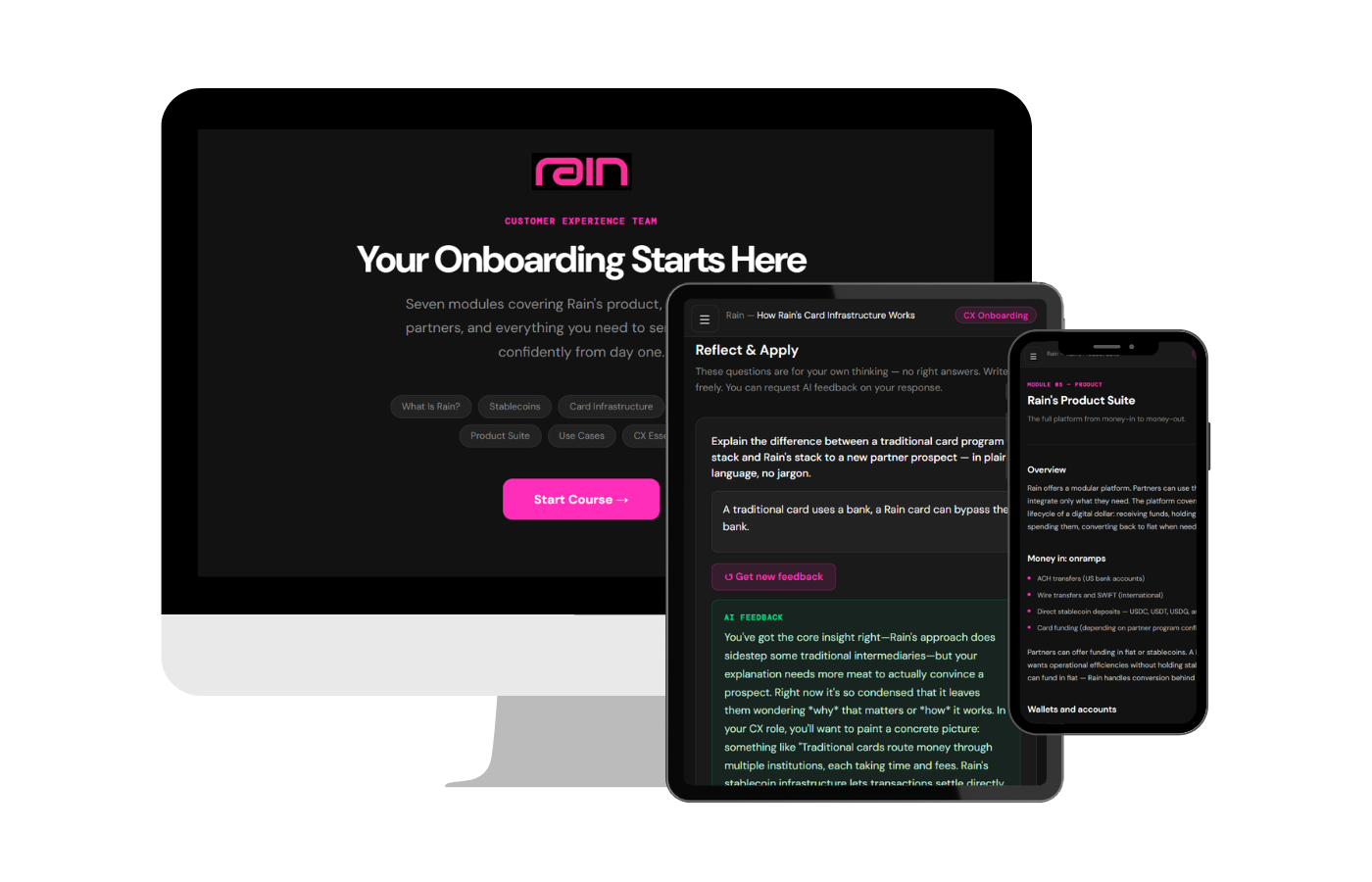
Rain CX Onboarding Course
7-module onboarding course built on Rain's product, infrastructure, and partner ecosystem — designed to get the CX team confident from day one.
built in under 30 minutes
claude-assisted content design
live ai feedback & knowledge checks
covers Rain product suite
designed for rapid deployment
MOCKUP
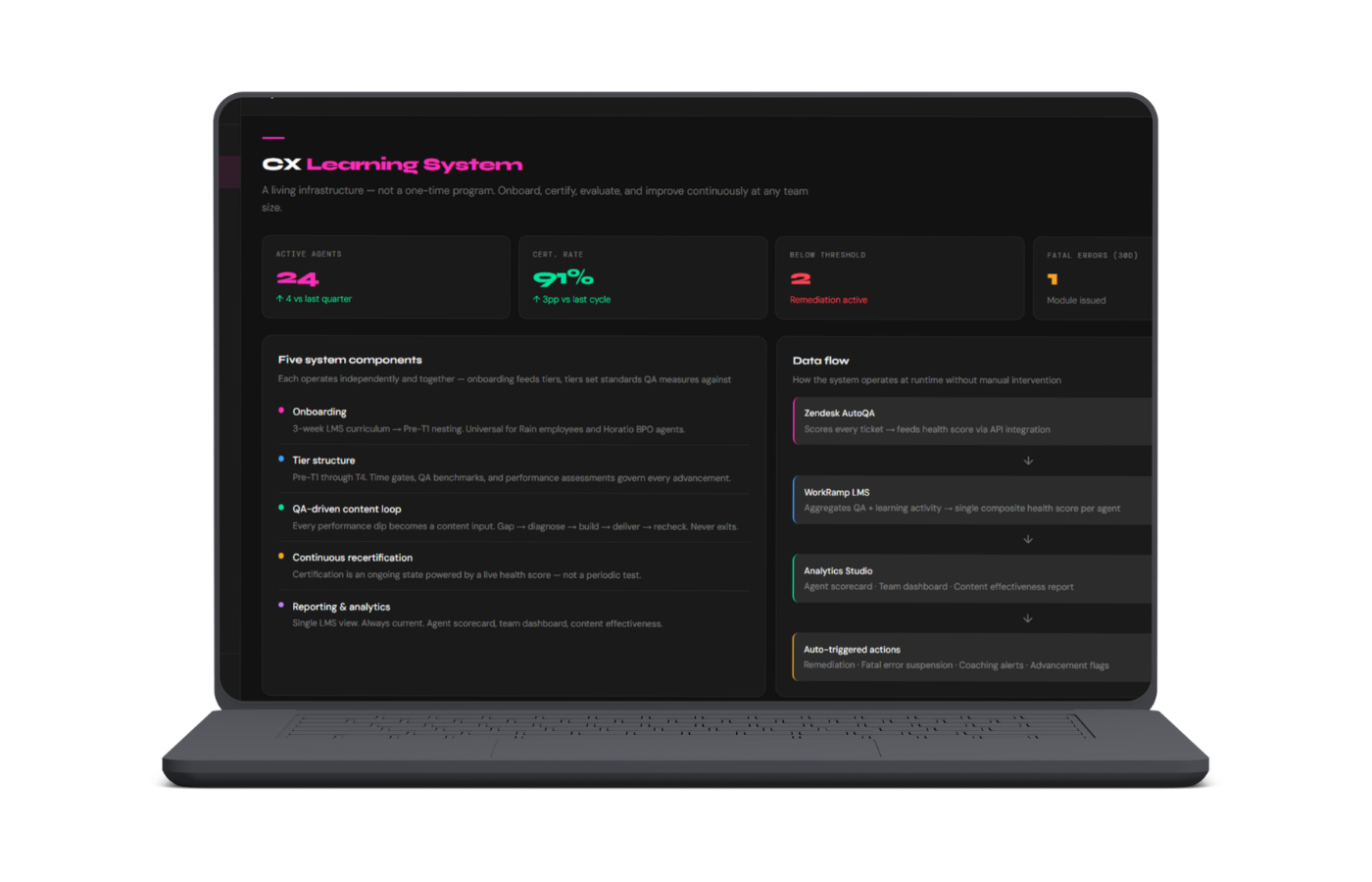
Rain learn
A live LMS design mockup built from scratch — including tier structure, learning paths, certification tracking, and a real-time agent health score dashboard.
full system architecture
tier progression from Pre-T1 through T4
live health score model with QA + learning data
segmentation across Rain and Horatio BPO agents
auto-triggered remediation and certification logic
Here's what I see, and what I could do about it.
-
Audit before I build anything.
Before writing a single piece of content, I'd run a real diagnostic. Pull Zendesk contact reason data, audit QA scorecards for calibration issues, map the current escalation path, meet with Horatio partner leads, and assess Rain's Notion documentation as the upstream content source.
Wide QA variance isn't a training problem until the measurement is confirmed consistent. High reopen rates aren't a content gap until I know whether it's a routing issue or a product depth issue. The deliverable at the end of month one is a findings report—not a course.
-
The highest impact fix first.
With the diagnostic complete, I'd start with the intervention that has the clearest data behind it. When empathy scores correlate with low CSAT, that's where I build first: a three-part sequence covering sentiment recognition, response selection with consequence, and a branching scenario that tests it all together. Fast to build, measurable signal within weeks.
In parallel, I'd begin the onboarding curriculum using Rain's Notion documentation as the content source, prioritizing the highest-volume ticket categories and clearest escalation risk. Everything built here is modular—labeled, categorized, and reusable across the full system.
-
An LMS that works like the rest of your stack.
Once the foundation is solid, the LMS becomes the delivery layer—and it should behave like one. Learning paths segmented by role, tier, and BPO partner. Certification assessments that are auto-scored and branch based on agent decisions. QA data flowing into agent health score views alongside learning completion data—no toggling between systems, no manual pulls.
The result is a live operational tool that tells managers who needs attention before it becomes a problem, and tells agents exactly where they stand at all times.
-
Extend the system. Don’t replicate the spreadsheet.
When the foundation is trusted and certification means something, BPO standardization actually works. Every Horatio agent moves through the same content and knowledge checks as a Rain employee. Certification criteria are system-enforced across every vendor. Product or policy changes push a required update module to every agent simultaneously—no separate coordination required.
Done in the right order, this is how a learning system scales without losing coherence or adding overhead every time the team grows.

No lms? no problem!
I was brought into my current role specifically to build and configure an LMS for customer-facing content—designing learning paths, setting up segmentation, and building reporting that connected training to real performance data. Over three years I've developed genuine technical depth.
I took the platform through a full rebrand after an acquisition: updating and rebuilding content consistently across a live system without disrupting what was already running.
I've also been through LMS procurement—evaluating vendors against real operational criteria, not just feature checklists. I know what questions to ask, what integrations matter, and what to pressure-test before signing.
I come in with a builder's mindset. I look for what the system should be doing, figure out how to get it there, and make sure it holds up over time.

“What truly sets Jess apart is her inquisitive nature, her relentless drive to find solutions, and her commitment to continuous improvement. She’s always thinking about how to make things better—more sophisticated, more polished, and more effective. Her willingness to contribute elevates the entire team.”
— Current Manager, 2025 Performance Reviewi don’t wear many hats. I see through multiple lenses.

Research taught me how people learn. Deploying technology forced me to scale it. Developing technical content pushed me to simplify it.
I bring all three of these viewpoints into building learning ecosystems that actually work.
read my resume
Highlights include:
15+ years in education and learning design
3+ years in technical product enablement
Ph.D. in Learning Technologies
tools i build with